
How Much Does Your AI Know About Your World?
Aug 17, 2026by Paul Kirch, BOSS Academy Founder
The AI giants may be running very different races. There's an important lesson in that for the rest of us.
We’ve become obsessed with asking which AI company is winning.
OpenAI?
Anthropic?
Google?
Grok?
AI is creating opportunities everywhere. I think we often focus on the wrong concepts and ideas, since it seems AI can solve everything (which it cannot). Even if you are "tool agnostic," it's important that we understand what's happening with the companies that are leading the way or opening the doors for progress.
I recently came across an article by Alberto Romero that made me think we may be asking the wrong questions or missing some of the real clues about the future of AI. In it, he discusses the concept of creating a world model, which sparked my thinking for this post. Allow me to take some creative license as I "borrow" this concept. In the article, he makes a provocative argument that Google may be stepping away from the AI race its biggest competitors are running. What does this mean for the rest of us?
The above companies and other leaders in the LLM space may not actually be running the same race.
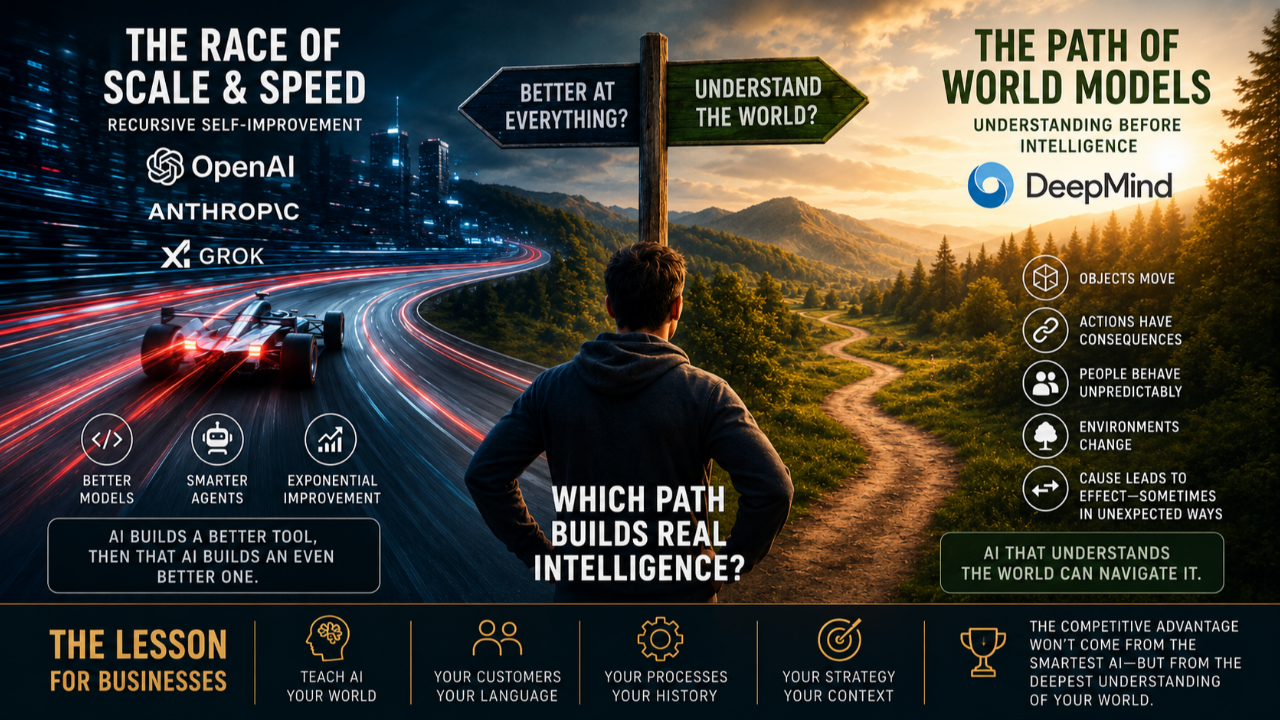
OpenAI and Anthropic are making a massive bet on increasingly powerful AI models, agents, coding systems, and something called recursive self-improvement.
Imagine an AI helping build a better AI. It sounds implausible, but given the progress we're seeing, many AI companies are betting on this. AI builds a better tool, and then that AI helps build an even better one.
Is that the future?
If that cycle continues, amazing things can happen.
In fact, if it works, the acceleration could be extraordinary.
However, Google DeepMind appears to be making a very different bet. Instead of simply creating AI that gets better at processing information, reasoning, coding, and predicting what comes next, DeepMind CEO Demis Hassabis has been heavily focused on something called world models.
And this is where things get fascinating.
Knowing Isn't the Same as Understanding
Today's AI can do some remarkable things, such as write software. It can analyze enormous amounts of information, solve complex mathematical problems, create images, develop strategies, and even help run parts of a business.
But does it actually understand the world in which those things exist?
Not from a human perspective.
Think about the difference between memorizing every book ever written about riding a bicycle and actually knowing how to ride one.
You could know everything about balance, momentum, steering, friction, braking, and gravity.
Then someone puts you on a bicycle.
I remember wanting to learn to rollerblade years ago. I bought a book, watched some tutorials, then jumped on the trail thinking I'd master the art of inline skating without a hitch.
My vision and the reality I faced were vastly different.
Instead of gliding down the trail, I wondered if I'd survive getting back to my car...
That's similar to the reality of expecting AI to navigate the world as a human.
Knowing and understanding become two very different things.
That distinction could become incredibly important in AI. A world model attempts to develop something closer to an internal understanding of how reality works. And that's considerably more complicated than simply knowing the information. How smoothly can AI glide down the path?
Objects move.
Actions have consequences.
People behave unpredictably.
Environments change.
Cause leads to effect, sometimes in ways we don't expect.
I've always believed context matters, but does AI understand how to provide the 'right' context?
The real world doesn't operate like a database.
And Neither Does Your Business
This is where I think this conversation becomes much bigger than Google versus OpenAI.
Businesses don't operate in perfectly predictable environments either. Customers don't always behave rationally. And of course, employees don't always follow processes. We also know that markets change. And we can't control how our competitors react.
In fact, it's a dangerous idea to "chase" our competitors' actions.
A strategy that worked yesterday may fail tomorrow.
And sometimes the most important information isn't sitting in a spreadsheet waiting to be analyzed.
It's buried in context that AI can't always understand.
This is why I think we're eventually going to see an important distinction between businesses that simply use AI and businesses that teach AI about their world.
I believe humanizing business is going to be more important than ever as we move forward.
So, borrowing Romero's concept, what's in your "world model"?
Your customers.
Your language.
Your processes.
Your history.
Your products.
Your competitors.
Your relationships.
Your successes.
Your failures.
Your industry knowledge.
Your world model is diverse, and it requires a human focus to understand how all these pieces work together.
What If We Stop Asking AI to Know Everything?
Is Google on the right path? I don't know.
But there's another lesson here for entrepreneurs.
What if your focus is understanding your world extremely well?
AI can support you, but you must be the guide for how it navigates your business and marketing world.
Don't just focus on AI knowing how to sell. Help it understand how you sell.
Help it understand the questions your best salesperson asks.
Define the signals that indicate a prospect is interested.
Are you identifying why customers hesitate?
What about which objections usually indicate a real concern and which ones are simply a polite way of saying no?
As you're building your world, take that idea throughout the organization and into different areas.
Marketing.
Operations.
Customer service.
Product development.
Leadership.
Suddenly, AI isn't merely a tool you ask questions.
It's one that's trained to help anyone navigate "your world."
After all, you define the context of your business.
The Question I'm Asking
We've spent the last few years learning how to prompt AI.
As we move beyond simple prompts, maybe the next stage is teaching AI enough about our businesses that we don't have to explain everything every time we use it.
That's a fundamentally different relationship from the way most of us leverage AI today.
Most of us see a victory when we feel AI can "sort of" write like we do.
That's a foundational piece, but I think we need to consider:
How much does your AI actually know about your world?
Because the next competitive advantage may not belong to the company with access to the smartest AI.
It may belong to the company that has done the best job teaching AI how its world actually works.
If you'd like to explore the thinking that sparked this article, I highly recommend Alberto Romero's fascinating deep dive, The Actual Reason Why Google "Fell Out" of the AI Race Changes Everything.
Don't miss a beat!
Follow our impactful blog and newsletter for tips to take your business to new heights.
We hate SPAM. We will never sell your information, for any reason.
